

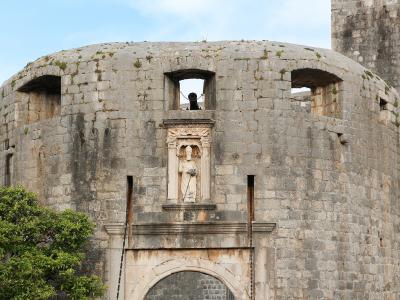
Pile Gate
Historic gateway to Dubrovnik’s Old Town and Game of Thro...

Walled Adriatic city with UNESCO heritage and coastal views
The center of Dubrovnik is its Old Town, a pedestrian-only maze of polished limestone streets, elegant squares and historic landmarks. The city walls, stretching nearly 2 kilometers and punctuated by towers and bastions, offer panoramic views of the sea, the old port and the terracotta rooftops below. Minčeta Tower, at the highest point of the walls, is the best-known of the towers, and Fort Lovrijenac, on a rocky promontory outside the walls, stood guard over the western approach and today is used as a stage for summer theatre. Walking the walls is a highlight, which provides insight into the city’s defensive history and wide views for photographs, but visitors should start early, since the stone gets very hot in summer.
Within the walls, highlights include the Stradun, the main street, called Placa in Croatian, the Rector’s Palace, Sponza Palace and the Baroque Cathedral of the Assumption, with its treasury of relics. The Pile Gate, with its drawbridge, is the main entrance, and the Large Fountain of Onofrio, built in the 15th century to bring water to the city, stands just inside. The Franciscan Monastery houses one of Europe’s oldest pharmacies, working since 1317, and its cloister is a quiet place, while the Dominican Monastery boasts a rich collection of art. The Maritime Museum and the War Photo Limited gallery offer deeper views of Dubrovnik’s seafaring and recent history. Fans of Game of Thrones will recognize many filming locations scattered through the city, among them the walls, the fort and the Jesuit stairs.
Beyond the Old Town, Dubrovnik’s coastline offers pebble beaches, hidden coves and clear water. Banje Beach, just outside the city walls, is popular for swimming and sunbathing, while the nearby island of Lokrum has botanical gardens, hiking trails and secluded spots for relaxation. Adventurous visitors can kayak around the city walls, take boat trips to the Elaphiti Islands or ride the cable car up Mount Srđ for sweeping views of the city and sea. At the top of Srđ, the old Imperial Fort holds a museum of the Homeland War, and the viewing terrace at sunset is one of the best in the country.
Dubrovnik’s lively harbor is a hub for boat excursions, seafood restaurants and sunset strolls. The city’s cultural calendar is packed with festivals, concerts and open-air performances, including the renowned Dubrovnik Summer Festival, which has run since 1950 and uses the squares, fortresses and courtyards of the old town as stages. Local cuisine features fresh Adriatic seafood, Dalmatian wines, black risotto, oysters from nearby Ston and Mediterranean flavors, best enjoyed in the Old Town’s atmospheric konobas and terraces. A sweet specialty is rozata, a custard pudding with caramel, a legacy of the old republic.
Historic gateway to Dubrovnik’s Old Town and Game of Thro...
Cable car to Mount Srd with panoramic Adriatic views
Highest tower on Dubrovnik’s ancient city walls
11th-century fortress guarding Dubrovnik’s coast
Baroque cathedral with 132 saint relics treasury
Historic limestone street linking Dubrovnik gates
15th-century fountain delivering fresh spring water
15th-century Gothic-Renaissance palace in Dubrovnik
Dubrovnik’s history dates back to the 7th century, when it was founded as Ragusa by refugees from nearby Epidaurum, today’s Cavtat. Over the centuries the city grew into a powerful maritime republic, rivaling Venice in trade and diplomacy. It was among the first states in Europe to introduce a quarantine for arriving ships, in 1377, and it abolished the slave trade in 1416. Its strategic location on the Adriatic made it a hub for commerce and culture, and its independence, which lasted until Napoleon’s arrival in 1808, was fiercely protected by the construction of massive stone walls and fortifications. In 1667 a great earthquake destroyed most of the city, and the Baroque buildings of the old town date largely from the rebuilding that followed. Despite earthquakes, wars and sieges, Dubrovnik has preserved its architectural splendor, earning its place as a UNESCO World Heritage Site.
The best times to visit are from May to June and September to October. During these months, the weather remains warm and the sea is inviting, but the crowds are smaller than in the peak season.
You can reach Dubrovnik via its airport, which has regular flights from major European cities, or by ferry. Once there, the Old Town is best explored on foot, while local buses and taxis are available for reaching other areas.
Key highlights include the Stradun, Rector’s Palace, Sponza Palace, and the Cathedral of the Assumption. You should also visit the Franciscan Monastery for its historic pharmacy and the Dominican Monastery for its art collection.
Visitors can swim at Banje Beach, explore botanical gardens on Lokrum Island, or kayak around the city walls. Other options include taking boat trips to the Elaphiti Islands or riding the cable car up Mount Srđ for panoramic views.
The city hosts the renowned Dubrovnik Summer Festival with concerts and open-air performances. Local cuisine features fresh Adriatic seafood and Dalmatian wines, which can be enjoyed in atmospheric konobas and terraces throughout the Old Town.
EUR
Croatian